

Rules and ethics
Part of Why customer success software rules and ethics shape UK buying decisions
How to check customer success software advertising rules before you buy
A checklist for UK buyers on the advertising, data and pricing rules that apply to customer success software, with sources to verify each claim.
What to take away
Customer success software advertising rules are the UK legal and regulatory limits on how vendors promote retention platforms. The same rules cover how your team uses customer data to market to its own customers.
- The Advertising Standards Authority applies the CAP Code to UK marketing claims, including vendor case studies and pricing statements. Rules 3.1 and 3.7 cover misleading claims and substantiation.
- The Information Commissioner's Office regulates direct marketing and the use of data brokers, which matters if you enrich retention campaigns with bought data.
- A quoted per-seat figure should be traceable and current, because pricing pages are commercial documents.
- Your own outbound retention messages sit under the same rules as the vendor's advertising.
- England, Scotland, Wales and Northern Ireland share the CAP Code and the UK GDPR.
This is general guidance, not legal advice. Individual cases need a qualified adviser.
Check the claims a vendor makes
Verify performance and case study claims
Ask for the evidence behind any retention or churn improvement figure. CAP Code rule 3.7 requires marketing communications to be substantiated, and rule 3.1 prohibits misleading claims. The ASA can act on a complaint from a competitor or a customer.
Complaints go to the ASA through its online complaints form. Data issues go to the ICO through its report a concern page.
Vendor claim checks
- Evidence for retention or churn figures
- Case study names baseline and period
- Testimonials are genuine
- Comparative claims substantiable at date made
If a vendor says a client cut churn by a stated percentage, the case study should name the measurement period and the baseline. Undated percentages from unnamed clients are a warning sign. CAP Code rule 3.45 expects testimonials to be genuine, and a comparative claim against a named rival must be substantiable at the date it was made.
An illustrative pair shows the difference. A non-compliant claim reads: Churn fell by 30%. A compliant version reads: In the 12 months to March 2025, a named client with a stated baseline of 2.0% monthly churn recorded 1.4% monthly churn in its billing system, a 30% relative reduction. The first gives no baseline, period or source.
Read the wider customer success software: UK rules and compliance guide for how advertising rules sit alongside contract and data duties.
Check pricing statements and totals
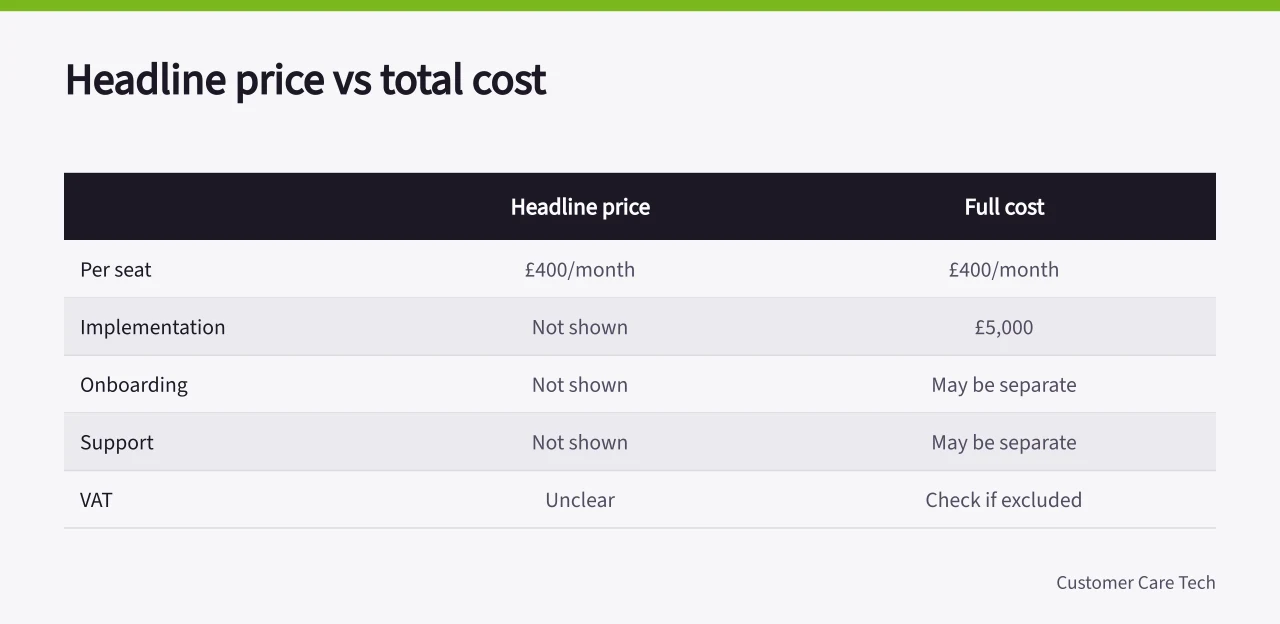
A headline price per seat is rarely the total. Check whether onboarding, implementation or support is charged separately.
Salesforce publishes its own Agentforce pricing tiers, which shows how a major vendor structures cost disclosure: Salesforce Agentforce Pricing.
Compare that with a vendor quoting one monthly figure and no breakdown. For example, a team paying £400 a month per seat may find a mandatory £5,000 implementation fee in the order form.
Check whether the quote excludes VAT and whether the rate is fixed for the contract term. A renewal uplift clause changes the figure you are really comparing.
Request these documents from the vendor
Request these documents
- Evidence pack for any retention or churn claim, with baseline, period and source.
- Full cost schedule, including implementation, support, VAT and renewal uplift.
- Consent wording and the page where it appeared.
- Data flow record showing what enters the platform, why and how long it is kept.
Check how data reaches your campaigns
Confirm your lawful basis for outreach
Retention marketing is still marketing. If you email or message customers about renewal, upgrades or add-ONS, the UK GDPR and the Privacy and Electronic Communications Regulations apply.
Consent or a valid soft opt-in must be recorded, and opt-outs honoured. Keep a dated copy of the consent wording and the page it appeared on, since the sender carries the burden of proof.
The ICO sets out what organisations must check before buying marketing data from brokers, which is relevant to data-driven retention: Organisations using marketing services of data brokers: what you need to know.
Separate product data from marketing data
Usage data inside a customer success platform can inform service messages. It should not be repurposed for promotional contact without a lawful basis. Keep a record of what data flows into the platform, why, and how long it is kept.
Our guide to customer success software data protection explains the records you need and the questions to put to a vendor before signing.
Check consent records and the comparison table
Choose foundations that record consent
A free or low-cost CRM can be enough to start, provided it logs consent and opt-out flags properly. HubSpot's free CRM is one option that supports contact records and marketing permissions: Streamline Your Entire Business With a Free CRM.
The point is not the brand but whether the record shows what a person agreed to, when, and through which channel. Export that permission history before migrating, because consent records often fail to transfer cleanly.
Run the before and after comparison
Use the table below to compare your position before and after the checklist. It is a working document, not a compliance certificate.
Before and after comparison
Before
- Vendor performance claims
- Undated percentage in a slide
- Pricing
- Headline per-seat figure only
- Marketing consent
- Assumed from purchase
- Bought data
- Used without checks
After
- Vendor performance claims
- Named baseline and measurement period on file
- Pricing
- Full cost schedule including implementation
- Marketing consent
- Recorded basis and opt-out flags in the CRM
- Bought data
- Broker checks documented before use
Common questions
Do advertising rules apply to software vendors or to my team?
Both. The CAP Code covers the vendor's marketing, while your retention emails and calls fall under UK GDPR and PECR. A complaint can be made about either side.
Can I use bought contact data for retention campaigns?
Only with a lawful basis and after checks on the broker. The ICO expects organisations to understand the provenance and consent status of purchased data before use.
How often should I review a vendor's claims?
At renewal and whenever a claim changes. An undated figure from two years ago may no longer be supportable.