

Measurement
Part of When to review customer success software measurement
Seven customer success software attribution methods compared
Compare seven customer success software attribution methods, from first touch to Markov models, with UK compliance notes and a numbered setup sequence.
What to take away
- Most teams reach for last-touch because it is the default in the tool, then wonder why renewal credit lands on the account manager rather than the onboarding programme.
- The right method depends on the decision it feedscampaign budget, onboarding investment, or renewal risk scoring. One method rarely serves all three.
- For campaign budget, use first touch or position-based. For onboarding investment, use time decay or U-shaped. For renewal risk scoring, use time decay or last non-direct touch.
- Multi-touch models need identity resolution first. Without it, you are attributing to the wrong account.
- Under UK GDPR, some attribution data flows are international transfers, so the lawful basis and transfer mechanism must be documented before you switch models.
- Test one method for a quarter before comparing it with another. Switching monthly produces noise, not evidence.
Why attribution goes wrong in customer success
The mistake most teams make first
They pick a model because the vendor lists it, not because a decision depends on it. A retention team wanting to know which onboarding step predicts renewal needs a different model from a marketing team splitting campaign spend. If no decision changes, the model is decoration.
A second error is treating attribution as a marketing-only problem. In customer success, the events that matter are product usage, support tickets, and business reviews. Those sit in different systems from ad clicks, so the join is harder.
The identity problem underneath
Attribution assumes you know which account and which person caused an outcome. In B2B, one buying committee can hold six contacts across two domains. If your customer success software cannot resolve those into one account, every model downstream is guesswork.
Fix identity before you compare models. That work also improves the reporting described in our guide to customer success software measurement and reporting, which covers the wider data model.
The seven models side by side
Credit logic
- First touch
- All credit to first recorded interaction
- Last touch
- All credit to final interaction before outcome
- Last non-direct touch
- All credit to final non-direct interaction
- Linear
- Even split across all touchpoints
- Time decay
- More credit closer to outcome
- Position-based (U-shaped)
- Heavy credit to first and last touches
- Data-driven or Markov
- Credit learned from conversion paths
Best-fit decision
- First touch
- Top-of-funnel channel choice
- Last touch
- Renewal risk scoring
- Last non-direct touch
- Campaign budget
- Linear
- Finance-friendly overview
- Time decay
- Onboarding investment
- Position-based (U-shaped)
- Acquisition and renewal balance
- Data-driven or Markov
- Large-scale optimisation
Data requirements
- First touch
- Complete first-touch log
- Last touch
- Clean outcome timestamps
- Last non-direct touch
- Direct visit filtering
- Linear
- Full touchpoint history
- Time decay
- Accurate event timestamps
- Position-based (U-shaped)
- First and last touch data
- Data-driven or Markov
- High volume of outcomes
Single-touch methods
1. First touch. All credit goes to the first recorded interaction. Useful when you are testing top-of-funnel channel choice, misleading for retention because it ignores everything after signup. Example: a webinar signup gets the credit even if the account only renewed after two product-led check-ins.
Seven attribution methods compared
Single-touch
- First touch
- All credit first interaction
- Last touch
- All credit final interaction
- Last non-direct
- Ignores direct visits
- Linear
- Even split all touchpoints
- Time decay
- More credit near outcome
- Position-based
- Heavier first and last
- Data-driven Markov
- Learns from conversion paths
Multi-touch
- First touch
- Ignores post-signup
- Last touch
- Overstates account manager
- Last non-direct
- Blind to middle
- Linear
- Treats support as campaign
- Time decay
- Needs clean timestamps
- Position-based
- Middle shared
- Data-driven Markov
- Needs high volume
2. Last touch. All credit goes to the final interaction before renewal or churn. Simple, and the default in most tools. It overstates the account manager's influence and hides onboarding quality. Example: a renewal credited to the account manager's final call, hiding that usage had dropped for six months.
3. Last non-direct touch. Same as last touch but ignores direct visits. Slightly fairer to campaigns, still blind to the middle of the journey. Example: a paid search click before renewal earns credit, while the support ticket that resolved the blocker is ignored.
Multi-touch methods
4. Linear. Credit is split evenly across all touchpoints. Easy to explain to finance, but it treats a support call the same as a paid campaign click. Example: a support call, a training webinar and a paid ad all receive equal credit for one expansion.
5. Time decay. Touchpoints closer to the outcome get more credit. Fits renewal cycles well, provided your event timestamps are clean. Example: a health check in month eleven carries more weight than the onboarding kick-off in month one.
6. Position-based (U-shaped). Heavier credit to first and last touches, the rest shared. A reasonable compromise when you care about both acquisition and renewal. Example: the onboarding kick-off and the pre-renewal business review take most credit, with routine usage updates sharing the rest.
7. Data-driven or Markov. The model learns credit from observed conversion paths. It needs volume. For a UK software firm with a few hundred accounts, the sample is often too small to be stable. Example: a model learns that support ticket sentiment predicts expansion, but only if you have enough renewal outcomes to train it.
For a narrower view of which events to feed these models, see customer success software key metrics in England.
Compliance notes for UK teams
Attribution often joins advertising identifiers with account records, and many platforms process that data outside the UK. The ICO's guidance on international transfers sets out the safeguards you need. Since 2021, UK transfers rely on the International Data Transfer Agreement (IDTA) or the Addendum to the EU Standard Contractual Clauses. Document the mechanism before you switch models, not after.
If your campaigns run on LinkedIn, the platform's own LinkedIn ad best practices explain how campaign structure affects the data you can attribute back. Poorly structured campaigns produce messy touchpoint logs regardless of model choice.
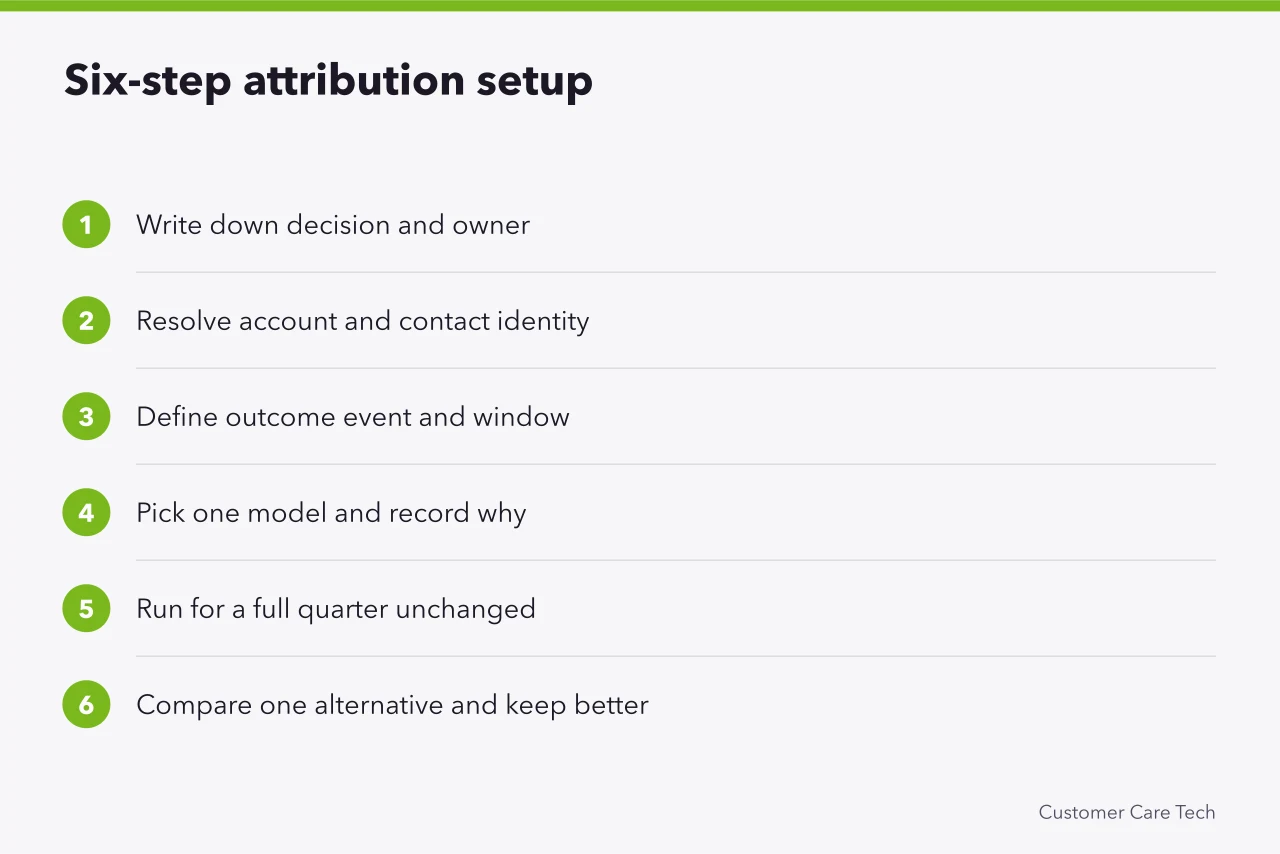
How to set up attribution in six steps
- Write down the decision the model will inform, and who owns it.
- Resolve account and contact identity across product, support, CRM and marketing systems.
- Define the outcome eventrenewal, expansion, or churn, with a fixed time window.
- Pick one model from the seven above and record why.
- Run it for a full quarter without changing weights.
- Compare against one alternative model and keep the one that changes decisions for the better.
Market size affects how much data you can expect. GOV.UK publishes business population estimates each year; the business population estimates 2016 edition is now historical, so use the current release for judging whether a segment holds enough accounts for data-driven attribution.
Common questions
Which attribution method is best for renewals?
Time decay or position-based usually fit renewal cycles better than last touch, because they give weight to onboarding and mid-term engagement as well as the final review. Test one for a quarter before judging it.
Can we run two attribution models at once?
Yes, and it is often sensible for a quarter, provided both use the same outcome event and time window. Comparing models built on different definitions proves nothing.
Does attribution need a legal review?
If identifiers are joined to personal data and processed outside the UK, yes. Check the transfer mechanism and record it, using the ICO guidance above as the starting point.
How many accounts do we need for data-driven attribution?
There is no fixed threshold, but small samples produce unstable credit. If you have fewer than a few hundred outcomes per quarter, a rule-based model will be more defensible.