

Reviews
Retention software checks: London, Manchester, Edinburgh
A UK guide to retention software checks: ICO registration, Article 28 data terms, contract clauses and due diligence for London, Manchester, Edinburgh buyers.
Retention software helps customer success, support and account teams spot churn risk, automate outreach and measure whether their retention programmes work. This guide sets out the checks to run before you sign in London, Manchester or Edinburgh: the data protection and financial services rules that apply UK-wide, the contract terms worth negotiating, and a due diligence checklist you can work through. It does not rank providers or quote prices, and the product categories are the same in all three cities; what changes is the law that governs the contract, the compliance evidence buyers ask for and how procurement is run. A platform of this kind rarely stands alone, so think about how it fits alongside your CRM and support desk customer success software vs CRM.
What the category covers and why your city matters
The phrase covers several kinds of product. It can mean a customer success platform with health scores and playbooks, a churn prediction tool, a journey automation engine, an in-app messaging system, or a survey and feedback platform. Most UK buyers combine two or more of those capabilities, and integration with your CRM, billing and support desk is usually more important than any single feature.
Location changes the buying process in four practical ways. First, procurement is run differently, from formal security reviews to an evaluation led by a head of customer success. Second, the sectors concentrated in each city change the compliance evidence a vendor must supply. Third, distance from the vendor's delivery team affects how much implementation and training happens on site rather than remotely. Fourth, the law that governs the contract can differ, which affects how terms are interpreted and which courts hear a dispute.
That last point matters. Contracts for businesses in London and Manchester are usually governed by the law of England and Wales. Contracts for businesses in Edinburgh are often governed by Scots law unless the parties agree otherwise. The practical effects include which courts hear disputes and how certain terms are interpreted. It is not a reason to avoid a vendor, but it is a reason to have the contract reviewed by a solicitor qualified in the relevant jurisdiction.
Data protection law is different. UK GDPR and the Data Protection Act 2018 apply across the whole of the UK, and the Information Commissioner's Office (ICO) is the UK-wide regulator. There is no separate data protection regime for Scotland, England or Wales. A platform processing customer data therefore needs a lawful basis, a retention schedule and a clear data processing agreement wherever your customers live.
Three UK buying environments
London
- Vendor pool
- Deepest
- Procurement
- Toughest
- Cost base
- Highest
- Buying risk
- Underestimated work
Manchester
- Vendor pool
- Smaller
- Procurement
- Pragmatic
- Cost base
- Middle
- Buying risk
- Overpaying
Edinburgh
- Vendor pool
- Specialist
- Procurement
- Compliance-led
- Cost base
- Lower
- Buying risk
- Overpaying
Legal and regulatory checks for all three cities
Before you compare features, confirm the vendor can meet your legal obligations. The checks below apply in London, Manchester and Edinburgh.
Under UK GDPR you need a lawful basis for processing personal data. Consent, contract, legitimate interests and legal obligation are the common bases for retention software. You also need to tell customers what you do with their data, how long you keep it, and how they can exercise their rights. The ICO publishes guidance on contracts and data processing agreements. Where a vendor processes personal data on your behalf, you need a written contract that meets Article 28 of UK GDPR. That contract must cover the subject matter, duration, nature and purpose of the processing, the type of personal data and categories of data subjects, and the obligations of both parties. It must also list sub-processors and set out how international transfers are handled.
The ICO also requires most organisations that process personal data to register, unless an exemption applies. Check that your vendor is registered where it needs to be. Our guide to customer success software data protection covers the detail.
If you are regulated by the Financial Conduct Authority (FCA), further rules apply. The FCA Handbook includes outsourcing rules in SYSC 8 and record-keeping requirements in SYSC 9 that affect how you use third-party systems. Edinburgh has a high concentration of financial services and fintech firms, so these checks come up more often there, but the rules apply to any FCA-regulated firm in the UK. Our article on FCA and Ofcom rules churn tactics explains how those rules shape outreach, and customer success software UK regulations gives a broader overview.
Data residency is another common question. If your vendor stores or processes data outside the UK you need appropriate safeguards, and the ICO provides guidance on international transfers. Ask where data is stored, which sub-processors are involved, and what happens on termination.
Local vendor presence
London
- UK HQ
- Most global platforms
- Local teams
- Account, delivery, support
- References
- Local
- Cost
- Highest salaries
Manchester
- UK HQ
- Few
- Local teams
- Thinner
- References
- London-based
- Cost
- Lower
Edinburgh
- UK HQ
- Specialist
- Local teams
- Regulatory focus
- References
- Financial services
- Cost
- Lower
Buying in London
London has the largest concentration of software vendors, professional services firms and customer success teams in the UK. That gives buyers more choice, but it also creates more noise. Your shortlist can fill quickly, and vendors know they are one of many, so expect to work harder for a tailored response rather than a standard pitch.
Formal procurement is common in London, even at mid-market size. Security questionnaires are long, and questions about data retention, subject access requests and sub-processors arrive early. Reference checks are standard and usually include at least one customer in a comparable sector. Vendors expect this and staff for it, which is why London deals often move slowly but predictably.
Implementation and consultancy can be scoped as fixed price or time and materials, so agree the delivery model and travel expectations in writing. Fix your requirements first, then compare what each vendor will deliver against them; a structured supplier comparison saves time.
Practical steps for London buyers: narrow your list by sector and integration needs rather than by vendor count; check Companies House filings for financial stability; confirm support hours cover your working day; ask for the named implementation lead and their relevant experience; and request a reference call with a customer of similar size.
Buyer scrutiny by city
London
- Process
- Formal procurement
- Security
- Long questionnaires
- References
- Standard, comparable sector
- Speed
- Slow, predictable
Manchester
- Process
- Pragmatic
- Security
- Commercial focus
- References
- Informal, local
- Speed
- Faster
Edinburgh
- Process
- Compliance-led
- Security
- Data residency
- References
- Regulatory evidence
- Speed
- Regulation-driven
Buying in Manchester
Manchester's tech and media cluster has grown quickly, with strong ecommerce, subscription and direct-to-consumer businesses. Those firms are natural retention software buyers because churn hits subscription revenue directly. If you run a subscription business, our guide to how to reduce SaaS churn UK covers the operational side.
Manchester's subscription and direct-to-consumer businesses tend to judge a vendor on delivery rather than on postcode. Ask how remote onboarding is run, who leads it, and what the escalation path looks like when something breaks during your peak period. A remote implementation is not a problem if the vendor can demonstrate successful ones with references from comparable businesses.
Manchester buyers are often pragmatic. The evaluation is frequently led by a head of customer success or operations rather than a formal procurement function, so decisions can be faster. Scrutiny still exists, but it concentrates on commercial outcomes: how quickly churn falls, how much admin the tool removes, and whether the team will actually use it. Take reference calls all the same, and ask what implementation actually involved against the original scope.
Negotiation in Manchester tends to focus on first-year commercial terms and local success management. Multi-year commitments are common where the vendor offers a named success manager, so ask what happens if that person leaves. Confirm that remote onboarding is included in the agreement rather than treated as an extra.
Pricing and negotiation norms
London
- Pricing pressure
- Highest
- Discounts
- Vendors discount
- Negotiation
- Implementation fees
- Renewal risk
- Uplift caps
Manchester
- Pricing pressure
- Middle
- Discounts
- Hard on year one
- Negotiation
- Multi-year deals
- Renewal risk
- Local success manager
Edinburgh
- Pricing pressure
- Lower
- Discounts
- Less focus
- Negotiation
- Contract terms
- Renewal risk
- Exit provisions
Buying in Edinburgh
Edinburgh is Scotland's fintech and data hub. Financial services firms, asset managers and data businesses make up a large share of serious buyers, and they approach a retention software purchase with regulatory obligations already in mind. FCA-regulated firms need audit trails, data residency answers and evidence of how the platform supports record-keeping, which narrows the field. Vendors without a credible financial services story rarely reach a second meeting.
Scots law is a practical consideration. If your contract is governed by Scots law, disputes go to the Scottish courts. That is not a barrier, but your legal review should cover the governing law clause, the jurisdiction clause and how termination and liability are handled. Some vendors will agree to English law if you ask; others will not. Decide early what you can accept.
Edinburgh buyers often evaluate remotely and travel for the final sessions, so build that into your timetable rather than treating it as a delay. Ask for financial services references and check whether the vendor has experience of FCA outsourcing rules. Data residency questions are more common here, so have your requirements ready before the first call.
A practical Edinburgh checklist: confirm data residency and sub-processor arrangements; ask how the platform evidences consent and deletion; check the governing law and jurisdiction clauses; request a reference from an FCA-regulated customer; and confirm support hours cover your working day. If you are regulated, map the FCA Handbook rules to your vendor checks before you sign.
Worked example: five vendors
London (3)
- Licence quotes
- Within 30%
- Implementation
- Varied by 2x
- Strength
- Integration depth
Manchester (1)
- Licence quotes
- Within 30%
- Implementation
- Varied by 2x
- Strength
- Price and local support
Edinburgh (1)
- Licence quotes
- Within 30%
- Implementation
- Varied by 2x
- Strength
- Compliance evidence
Contract terms to negotiate in any of the three cities
The same contract issues appear in all three cities. Negotiate them before you sign.
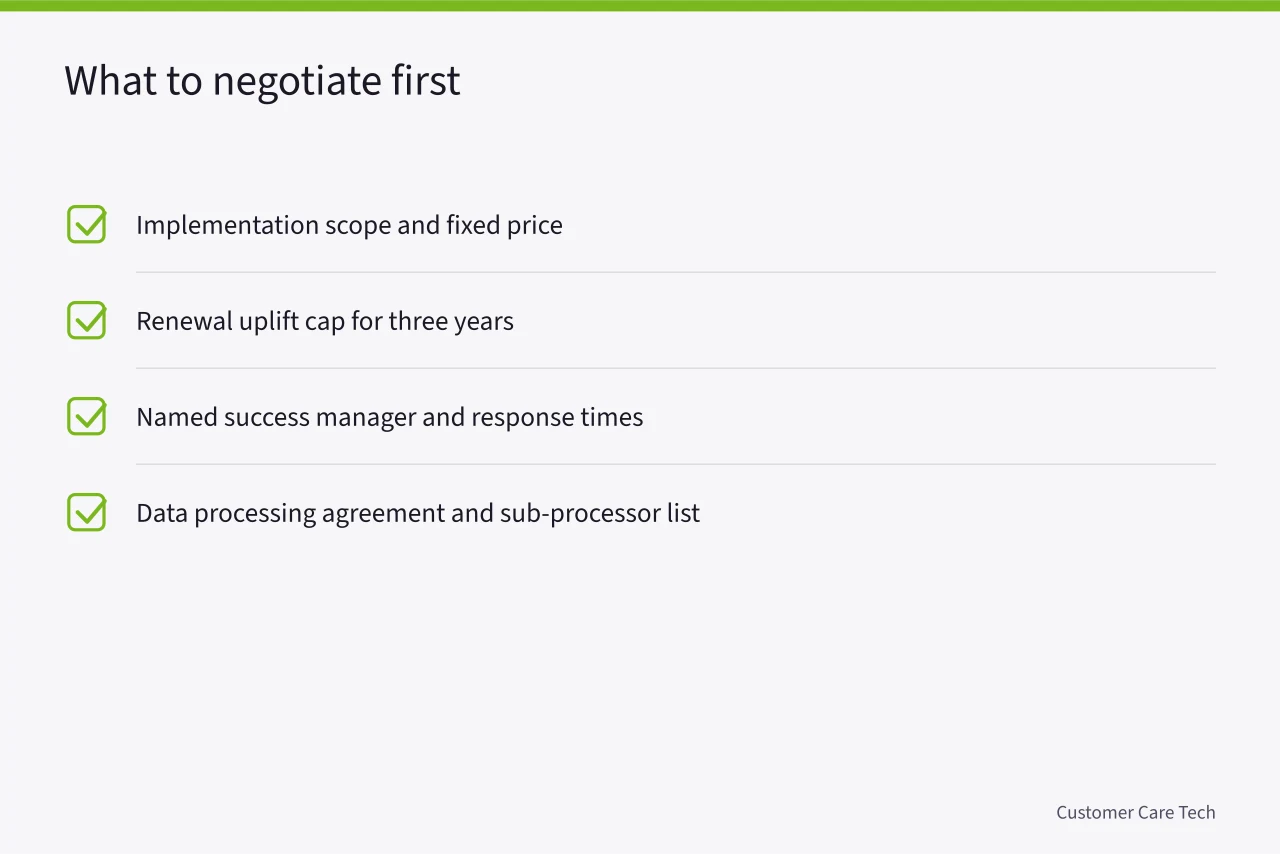
Renewal clause. A modest first-year arrangement with uncapped renewal terms is a bigger risk than a higher fixed commitment. Ask for the renewal terms in writing before you sign, and treat a refusal to cap them as a risk in itself.
Exit assistance and data export. Specify the format of your export, the timeline for delivery and any conditions attached. You should be able to export customer records, health scores, playbooks and history in a usable format, and you should test the export before you commit.
Support hours. Confirm that support covers your working day and your peak periods, and define severity levels and response times in the contract. If your team works across time zones, check whether extended coverage is an extra.
Implementation scope. Agree the scope in writing. Fixed-scope implementation is easier to budget but only works if the scope is clear; time-and-materials contracts need a change control process. Ask who owns the project on the vendor side and what happens if that person leaves.
Data processing agreement. The DPA must meet Article 28 of UK GDPR. It should list sub-processors, describe security measures, set breach notification timelines and explain how international transfers are handled.
Pilot period. Ask for a pilot with agreed success measures. It reduces risk and gives you evidence for a full rollout, provided the success measures are agreed in writing before the pilot starts.
Due diligence checklist for UK buyers
Work through this before you invite any vendor to a second meeting. It applies in London, Manchester and Edinburgh.
- Check the vendor's Companies House filings for financial stability. Look at accounts, the confirmation statement and directors.
- Confirm the vendor's ICO registration where applicable, and check its data processing agreement against Article 28 of UK GDPR.
- Ask for a security summarycertifications, penetration test summary, incident history and business continuity arrangements.
- Request a sub-processor list and confirm where data is stored.
- Ask for reference calls with customers in your sector. Ask what implementation actually involved against the original scope, how long it took before the team stopped needing vendor hand-holding, and what they would negotiate differently.
- Test the data export format and completeness before you sign.
- Confirm support hours cover your working day and peak periods.
- Agree a pilot period with success measures.
- Check the contract's governing law and jurisdiction, especially in Edinburgh or when contracting with a Scottish entity.
- Set internal success measures for the rollout, not just vendor measures.
For more on comparing vendors, see our product comparison guide and the selection checklist.
UK buyer comparison checklist
- Confirm similar size and sector customers
- Check data storage and sub-processors
- Ask about UK GDPR subject access
- Get implementation scope and price in writing
- Ask for renewal uplift in writing
- Speak to two references you chose
- Agree exit terms and data export
A table can help you compare practical differences across the three cities without ranking them.
London
- Legal jurisdiction for contracts
- Usually England and Wales
- Data protection regulator
- ICO (UK-wide)
- Financial services regulator (if applicable)
- FCA (UK-wide)
- Vendor field
- Largest concentration in the UK
- Procurement style
- Often formal, detailed security reviews
- Travel and remote delivery
- Local vendors common
- Key extra checks
- Integration depth, local references
Manchester
- Legal jurisdiction for contracts
- Usually England and Wales
- Data protection regulator
- ICO (UK-wide)
- Financial services regulator (if applicable)
- FCA (UK-wide)
- Vendor field
- Smaller, some northern specialists
- Procurement style
- Often led by CS or operations
- Travel and remote delivery
- Some remote delivery likely
- Key extra checks
- Remote onboarding, subscription references
Edinburgh
- Legal jurisdiction for contracts
- Often Scotland, unless agreed otherwise
- Data protection regulator
- ICO (UK-wide)
- Financial services regulator (if applicable)
- FCA (UK-wide)
- Vendor field
- Smallest, specialist-led
- Procurement style
- Often compliance-led
- Travel and remote delivery
- Remote evaluation common
- Key extra checks
- Scots law, FCA outsourcing rules, data residency